Richard Garlick talks to Men in Blazers – full transcript

As the clock ticked towards 11pm yesterday and it became increasingly apparent that Arsenal weren’t about to pull a rabbit out of a hat in the transfer market, Men in Blazers released an interview they’d been sitting on for a couple of weeks with Arsenal CEO Richard Garlick.
We’ll stop short of suggesting the timing was a stitch-up, but it was pretty amusing, particularly given how bullish Garlick is about the club going to the next level, building on last season’s title and establishing a period of sustained dominance. His closing message, that Arsenal want to become “serial champions” and are aiming for “the start of a dynasty”, probably landed a little differently after a deadline day on which the club failed to add the attacking reinforcement many supporters were expecting.
If you’re willing and able to look beyond that frustration, which undoubtedly coloured the mood yesterday, there’s still plenty of interesting and relevant stuff in the interview. For one, it’s useful to hear at length from a man who plays a pivotal day-to-day role at Arsenal but generally keeps a relatively low profile.
Garlick discusses his route from private-practice lawyer to football executive, what being Arsenal’s CEO actually entails and how he works alongside sporting director Andrea Berta, director of football operations James King, Mikel Arteta and Josh Kroenke on transfers.
More broadly, he returns repeatedly to the importance of alignment and stability, with the ownership, board, manager and staff all pulling in the same direction. It’s something he believes has given Arsenal an advantage amid the usual chaos of the Premier League.
There’s inevitably plenty of corporate speak along the way, but also enough detail about how Arsenal operates behind the scenes to make the full interview worth a read/watch.
Here’s a transcript…
On Arsenal’s progress since he joined in 2021 and how this summer has been different…
The ambition that the club has has always been there. We’ve always wanted to get back to the top, but get back to winning major trophies. When I arrived at the club, we obviously weren’t in Europe, and the first task was to get us back into the Champions League. And we did that, and then we pushed on, and we accelerated that success to the point where we were challenging for titles much quicker than we expected. Now we’re title winners. We’ve got to that stage. We just want to push on. We want to win more. The ambition is there for the club.
On the Premier League title being the start rather than the end of something…
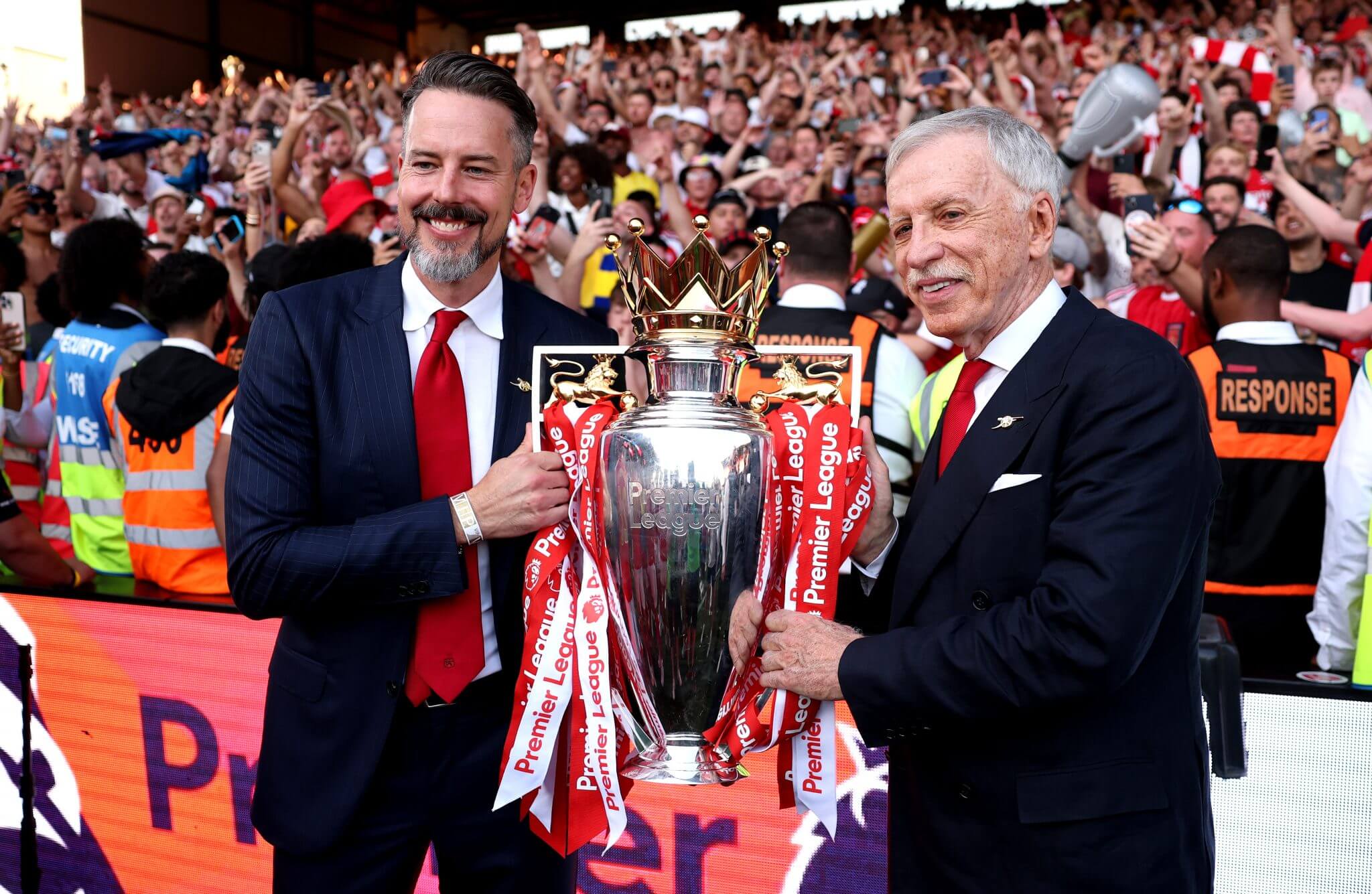
There was a moment where we enjoyed it, and you saw that enjoyment, whether it’s the players celebrating the actual win, whether it’s a trophy lift, whether it’s that parade around North London, which was absolutely amazing, or the scenes you saw around the world. We are absolutely saying, we’re not done here. This is the start, not the end. We’re at the start of something big. We want to push on and win more and more. It is trophies, plural. It is absolutely trophies, plural [we’re after].
On the role of a CEO at a football club…
The main focus for me is to create an environment where people can win and people can succeed, whether that’s on the football side, obviously, but also from a commercial point of view, with our supporters and with our staff, and bring everybody together, where everyone feels that they are part of something bigger, that they’ve all got a contribution to make, that they all feel valued, and they can all understand that when they arrive in the morning, they are clear of what their job and what they want to do. But as I say to the staff, every one of them contributed to that win this year. And when that happens, everybody feels part of something special. So as I say, generally, what a CEO should do in a football club is bring people together around a common purpose and create an environment where you can win.
On how he became a Premier League CEO having been a player, a lawyer, a director of football…
Well, I think you’ve summarised my background there. I was a lawyer, a lawyer to start with, not in connection with football or sport, really. And I had one of those sliding-doors moments where I happened to be acting for a football club, Plymouth Argyle, who played West Bromwich Albion in a match towards the end of the season. Jerome Thomas, an ex-Arsenal player, had committed a foul, been sent off and created a huge brawl, a huge fight on the pitch. I was representing Plymouth, and a guy called Darren Eales, who started off at West Bromwich Albion as their legal director and legal counsel, was leaving to join Spurs. West Brom were advertising for a lawyer / club secretary,so at Wembley, I got chatting to Darren about the role and Jeremy Peace, who was the chairman of West Brom at the time, was there as well. Basically, what you’ve said about my background, law and football [helped]. And I lived five minutes from West Brom’s training ground! They said, why don’t you put your hat in the ring? And two interviews later, I got a job and had to make the decision to come out of private practise as a lawyer and take the step into working at West Bromwich Albion. And then the first game that we had away at Chelsea, we lost 6-0.
On how he categorises a multi-faceted business like Arsenal…
We’re a football club, first and foremost. Our job is to win major trophies. And that’s the element of a football club. But we want to do it, as I said, in a financially sustainable way, which means we need to grow our revenues, which means we need to focus on partnerships, on our venues, on our retail and all those sorts of areas as well. But we also want to be a club that wins with our supporters. We’ve been on a journey on that. And I think we’re in a really good place. We’ve done a lot of work to connect up our supporters, not just from a pure sort of watching football matches point of view, but from a cultural point of view as well, really getting involved in the community. We’ve got such a strong community base, such a strong Foundation that works around North London, but around the UK and also around the world. And maybe some of the viewers have seen some of the work that they’ve done, like the foundation in Zaatari in Jordan, the refugee camp there. We really want to create that winning club, winning culture and winning community. And everybody that works at Arsenal knows that if we can win with all those different elements, we’re going to be successful.
On how his role dovetails with sporting director Andrea Berta, particularly when it comes to transfer talks…
So beforehand, you’d be preparing what you’re looking at for a summer plan in terms of the ins and outs. And that’s in consultation with, obviously with Mikel [Arteta], Andrea and James King. Speaking to myself and Josh [Kroenke] around what the plans might be. Obviously, Josh plays a key role in being across that and understanding the motivation of why we might want to change players or strengthen certain areas. Ultimately, Andrea and James have the responsibility of opening up the contacts and the negotiations. I used to be in James’s role, so I understand how that works. And I have sat in Andrea’s seat, not at Arsenal, but when I was at West Bromwich Albion. They pull the work together, and then they will report back. And ultimately, we’ll get to a point where we’re all comfortable with going ahead and executing it. But to be fair, it’s Andrea and James who do all of the trading, all the negotiations. I kind of try and help in the background where I can in terms of creating that environment in which they can succeed, whether that’s helping from the finance side with the ownership or whether it’s helping from the legal side or every now and again having to maybe get involved in discussions with my counterparts at those clubs if there’s a challenge or we’ve had a bit of a bump in the road just to try and find a solution to it. But predominantly, it’s down to Andrea and James.
On the secret to good negotiations…
Well, I think you need to go in with a clear idea of what you want to achieve. You need to keep your eyes on the prize, but you need to do it in a principled way and try and stick to the principles that you have as a club and that we would have as a football leadership team. We try and do things sensibly, but you want to get the job done. Usually, people say in a good negotiation, everyone comes out slightly unhappy because that’s the place where they want to be. Ultimately, we want to have a player at the end of that transaction that’s going to come in and be very, very happy. Maybe it’s their agent that’s not so happy or maybe it’s us that are not so happy with the agent. But in the end, we want a happy player.
On what Arsenal stands for…
Arsenal is unique in how it stands, and you saw that with the connection that we had when we won the Premier League. I was on one of those buses that was going around North London. We can have a back-and-forth as to how many people were there. I suspect there were around at least a million people out there. A million sounds like a good figure to me. Anyway, it was a lot of people, but it was a lot of people who might not have always had the opportunity to come to the Emirates to watch Arsenal play, but had felt that there was a connection with the club, whether it’s on a local scale or community scale. And just the passion! For two hours, I’ve never experienced anything like it. What Arsenal was about was what you saw there: a cultural connection with the local community. But it was also wider than that, because I know in the US, for example, the Empire State Building got lit up [in red and white]. In China, the Canton Tower got lit up. You saw in Africa, people celebrating in the streets. It was a worldwide phenomenon. And I think that’s only something that Arsenal could connect with.
On what the global fanbase was connecting to…
I think they were connecting to a family. They were connecting to something that they could see that they could belong to. Arsenal is a very open, welcoming club. It’s been that way right from the start. And the way in which we have worked with what started off as just the local community around North London, and the work that we do in engaging with the community and the local area, has then spread. And people feel like they want to be part of that. When they look at Arsenal, they can connect with it, whether it’s with its players, whether it’s with the women’s team, whether it’s with our academy players coming through, whether it’s with our legends, but also with the staff that we have. We want to feel that when you come to Arsenal, when you come to the Emirates, however you interact with the club, you go away with a good feeling. And I think you saw that connection that we have. You saw that being part of a family. And who wouldn’t want to be part of a family? You know, if you’re around the world, wherever you are coming together as a community, whether it’s in New York or whether it’s in Philadelphia, whether it’s in Los Angeles, in the United States alone, we’ve got 87 supporters’ groups, which are more than the number of states that there are in the US. And you could see that they all felt like they belonged to something. That’s the unique thing that I think that Arsenal’s got. It’s that when people look at Arsenal, they feel a connection, they feel a family, and they want to be part of it.
On how Arsenal stay relevant to both local and global audiences…
By having a great team around me that listens and that makes sure that we are supporting all of the Arsenal family. Last year, we gave away to the community over a thousand tickets so that local people could still come in and connect. We had open training, where people can come in and connect. You want to give the local people that opportunity to come to the Emirates. But also the stuff that we can do in terms of outreach, in terms of some of the community programmes that we’ve got through our fabulous community team that are delivering, whether it’s football courses for young people or whether it’s education support. There is that way in which we can do. But you’re right, people also want to see who’s connected with Arsenal. Some of the names that you just said there in the US, Jason Sudeikis has been to quite a few matches; Spike Lee has been to a few matches as well. And so we can connect on that. But it’s in a humble way. We’re trying to do it in a natural way. They’re coming to Arsenal because they support Arsenal. They’re not coming because they’re just trying to show up at a big event. It’s a genuine connection is what I’m saying. It’s not manufactured.
On this summer’s biggest challenge…
Making sure everybody understands that this is the start of the next chapter, not the end of something. We’re not going to sit here and pat ourselves on the back saying, “Yeah, we’ve cracked this. Let’s put our feet up.” It’s actually, let’s go again. What can we do? Whether it’s driving new partnerships or new retail ventures, whether it’s driving a new connection with the fans, whether it’s introducing some safe standing areas in the Emirates, whether it’s investing further in the team, men’s and women’s teams. Our motto is “Always Forward” and we need to embrace that. And people and the staff and the supporters need to realise that we are going to continue pushing forward. We’re not going to sit here and be complacent. We need to drive each other forward so that we can continue to win and dominate football in the coming years.
On Arteta’s intensity and the responsibility he bears on his shoulders…
Yeah, he is relentless. There’s a lot of people around Arsenal that are relentless in their pursuit of making Arsenal better in whatever way that is. We speak to Mikel a lot about the support, and he feels he’s got a team around him, whether it’s the team that’s the board or the ownership, there’s a real strong connection there where he feels supported. He’s got really good staff that he’s very loyal to, and they’re loyal to him. And he reaches out to a wider connection of friends and colleagues other than just in football. You know, [LA Rams coach] Sean McVeigh is somebody that he talks to a lot. I’ve seen him speak with Sean in the dressing room of the Rams, after a Rams game, where Mikel’s just absorbing what Sean does, how he reacts, and then they’ll speak about maybe common challenges that they’ve got. He’s got a good network of people that he reaches out to.
A bit like we all have every now and again, you need someone to speak to, someone to maybe bounce ideas off.
On Josh Kroenke’s influence…
He brings that stability. He brings that knowledge. He’s got a passion for winning, and we are part of a family that are serial winners, whether it’s the [Denver] Nuggets, whether it’s the [Colorado] Avalanche, whether it’s the [LA] Rams, they’re all serial winners. And I mean family in the widest sense, in terms of knowledge [sharing]. He is, as you said back in 2019, he was desperate to see Arsenal succeed, to put Arsenal back on the path that they should be on. And he’s worked hard, and he’s had a great team around him. When you’ve got really good people in the right place, who’ve got a plan and they all align behind that plan, you’ve got a very good chance of winning. It doesn’t matter how good or bad that plan might be, but if you’ve got a plan and everyone’s aligned to it, you’re going to go really far.
On Arsenal having stability amidst the chaos of the Premier League…
100 per cent. And we’ve got in Mikel, that stability, that strength that we’ve had over the years, and he’s been part of that, obviously, along with Josh and other members of that team. And you can see now it’s come to fruition, and we need to build on that platform of stability that we’ve got. It gives us an advantage.
On how winning the league changes his role and what it changes for the club…
I don’t think it changes my role in that the ambition is still the same: to keep winning, to keep pushing Arsenal forward. I think it unlocks a confidence in the club. You can see that when you, when you see that connection with the wider Arsenal family, it gives us a confidence and an ambition to go ahead and dominate the next few years. It puts us where Arsenal should be, at the top of the tree and winning major trophies and winning major titles. It sets us up for success in the future because I think the success that we’ve got now is just the start and there’s so much more to come.
On his message to the Arsenal fans…
I dream of us being serial champions, of us repeating what we did last year and going one better, maybe in the Champions League and winning major trophies. This is a period of dominance. You could call it a start of a dynasty. This is what we’re aiming to do. We’re aiming to dominate football for the next few years on every front.
The post Richard Garlick talks to Men in Blazers – full transcript appeared first on Arseblog News - the Arsenal news site.