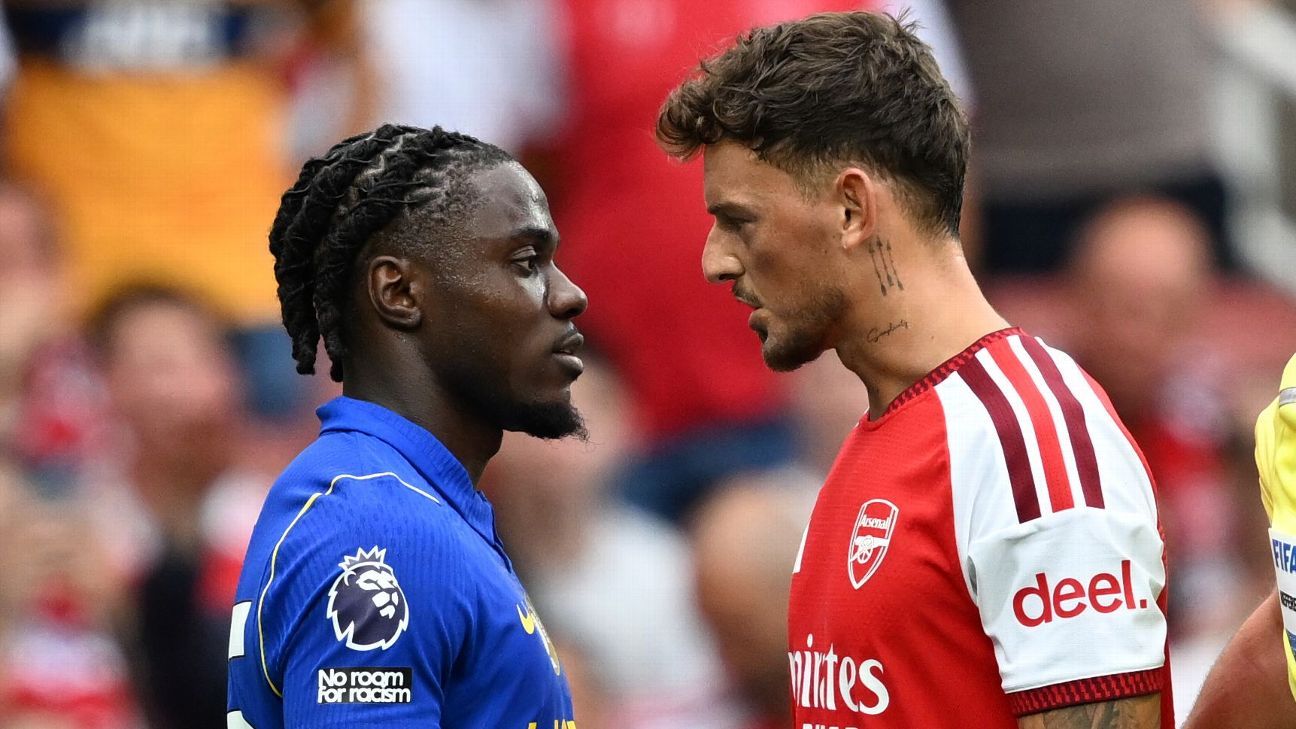
‘Safety, security and service’: behind the scenes with police at Arsenal v Chelsea

Facial recognition and spotters part of operation at Emirates that involved a dozen incidents and two arrests
The concourses are silent when, deep in the Emirates Stadium’s bowels, Chief Inspector Pete Dearden’s briefing begins. Arsenal’s 4.30pm kick-off against Chelsea is still hours away but the fixture carries significance as a London derby and because the Premier League champions are hosting a realistic challenger.
Dearden is a senior officer in the Metropolitan police’s public order command and Sunday’s matchday commander. He is, to borrow football jargon, giving the pre-match team talk, running through intelligence and in-game tactics. “Set the right style and tone,” he says. After Dearden has finished, the police room becomes a pseudo-station for the afternoon, with all incidents triaged by the same crime officer. Football offences can be found in niche legislation, and the Met wants London’s matchdays to be, so far as possible, policed uniformly.
Matchday is the iceberg’s tip. The Met’s 17 dedicated football officers (DFOs) each work full-time on one club, planning each fixture with the matchday commander. All 500-plus games the Met covers per season are risk-graded using factors such as risk level of supporters, proximity, recent history and kick‑off time. Dearden labels Sunday’s game “medium medium”.
“Our mantra is safety, security and service,” Dearden says. “We appreciate that with 60,000 people in the stadium not everybody is going to behave, but we want to reduce the overall risk of the likelihood of disorder.”
Three police support units (PSUs), each containing an inspector, three sergeants and about 21 constables, have been assigned to the match. In addition, there are the senior team and 20 operational football officers, or “spotters”, on duty.
Clubs also have their own in-house safety teams, with, in effect, both parties doing their homework before collaborating. Arsenal’s operation involves about 1,000 stewards and response team members. They are the first responders to any incidents within Arsenal’s footprint. When a Chelsea fan overzealously reacts to his team’s early lead, the response team remove him.
Stadiums are not policed as standard, but clubs can request (and, if the request is accepted, pay for) special police services (SPS). Arsenal asked for one PSU to work within the Emirates for Chelsea’s visit but even then, police intervene only when required. Dearden estimates policing football costs the Met £23m a season, with approximately 10% recovered from clubs for SPS.
The Met is looking to close that gap, with aspects such as road closures and hostile vehicle mitigation now managed, and financed, by clubs. Dearden says his department is looking at “mitigation measures to reduce risk, which means that we don’t have to have as many police resources and we don’t compromise safety and security”.
Using spotters is one such measure. They work under the DFOs, are usually locally based for their day-to-day duties and operate consistently with one club. Dearden estimates that their expertise allows them to do the work of double the number of public order officers that would otherwise be needed. “They will go to pubs in the wider footprint where these people gather and try to identify what their plans are, get a good feeling for their mood and the numbers,” Dearden says.
Some Chelsea spotters are in Holborn and will follow when supporters journey to Arsenal by tube. Fans being unwilling to engage with spotters may indicate they are planning something. “You can get a good idea of whether they are potentially going to cause problems at a game because of that lack of engagement,” Dearden says. “It’s that communication approach again – even with some of the supporters that cause us problems, albeit a minority, there’s still engagement to be had. There are still opportunities to say: ‘Don’t do that.’”
Immediately before the match one spotter performed CPR on a supporter. The intervention was life-saving.
Outside the Emirates, two blue vans contain officers monitoring the data from cameras scanning passersby as part of an intelligence‑led live facial recognition pilot. The trials were funded thanks to a multimillion-pound Premier League investment.
Passing the cameras is voluntary, with signs alerting pedestrians to their presence. Faces are biometrically scanned and compared with a watchlist containing the several thousand people subject to football banning orders (FBOs) and individuals wanted for more serious crimes.
“We are targeting high-harm offenders, sex offenders, those with FBOs, who, if they came to an event, could spoil it for others, commit crimes, or exploit opportunities such as crowded spaces,” Dearden says.
The two-hour pilot yields six interventions, one while Guardian Sport is present. Officers intervene to speak to the individual, who is with their family. They have an FBO, although are not restricted from being around the Emirates. They have also recently been released from prison for human trafficking and are wearing a tag.
Dearden feels half a dozen hits is proportional to what would be expected. “What we can’t measure is the deterrent effect,” he says.
Noticeable is the relative lack of police visibility compared with recent years. That is by design, not accident. A heavy police presence does not necessarily make an event feel safe. “We don’t work on a ‘just in case’ basis these days,” Dearden says. “We deal with known knowns.” Arsenal fans in Naples on Wednesday are likely to meet a vastly different approach.
Immediately before the match, the Guardian laps the ground with the day’s three-person violence against women and girls (VAWG) team. “We want to change the culture of what perhaps in the past was tolerated,” Dearden says, giving the example of staff being targeted with misogynistic abuse.
“We’ve had people at football matches come forward and say: ‘I’ve heard you talk three or four times now and I’m now confident enough to report that I think I’m a victim of domestic abuse and controlling behaviour.’”
The VAWG team are also watching for those who may target vulnerable individuals.
For the match, Dearden heads to the command room with Arsenal’s safety team and the other emergency services. Proximity and open dialogue are vital. Because of the game’s risk level, there is a bronze commander, Inspector Rachel Duckett, at ground level. A half-time briefing allows all parties – including medical, the London fire brigade, the local authority, the Premier League, and British transport police – to compare notes and address issues. Dearden and Duckett then discuss the strategy for the game’s end.
For all the planning, much of what happens at football is result-driven. With Arsenal 2-1 up and time running out, a late Chelsea equaliser might have changed the mood. Home and away fans cross paths after, outside the 3,000-strong Chelsea end, where there is no cordon. Arsenal supporters gloat; some Chelsea fans react. A pair of Chelsea content creators try to record in the middle of the departing crowd and receive an expletive-laden reaction from passing Arsenal fans. They are advised to move on for their own safety.
Striking is the speed at which potential flashpoints are spotted and then defused. Officers are calm, not confrontational, and act as an external subconscious: “‘C’mon, think – do you really want to do that?’”
An hour after the final whistle, the stadium is silent again, and Dearden and his senior team debrief pitchside. A dozen incidents occurred around the game, with two arrests made – one for assaulting a steward and another for racial abuse and assault. A further 10 people were reported for offences including drinking in view of the pitch, missile throwing, low-level assault of a steward, homophobic chanting and possession of drugs.
Dearden says the number is “slightly higher than we’d like” but points out that it demonstrates proactivity. For example, stewards are told not to tolerate pushes as simply part of the job. Outcomes will be proportionate and consistency is key. In the days and weeks ahead, everything will be analysed, assessed, fed into data. Incremental improvement will be sought and further action may be required for the reported incidents.
But, for a few hours at least, all involved can reflect on a matchday’s work completed well.